Farm Equipment Outline Icons: The Minimalist Visual Toolkit for Modern Projects
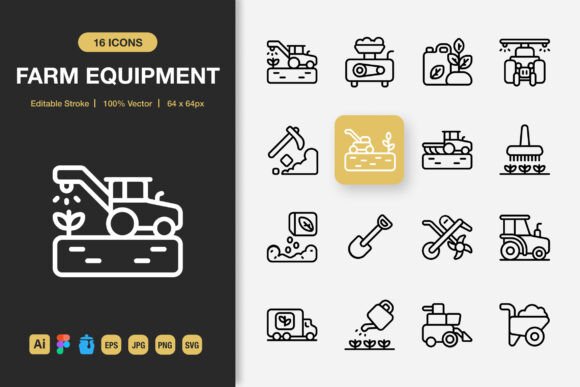
When your project calls for a visual representation of agriculture, machinery, or rural life, the right icons can make or break your communication. A set of Farm Equipment Outline Icons isn't just decorative clip art; it's a functional design system. These minimalist, outline-style icons serve as a clear, versatile vocabulary for a wide audience, from app developers creating a farming simulator to educators designing a textbook on sustainable agriculture. Their simplicity is their power, ensuring they remain legible and impactful across any medium you choose.
The Overlooked Details That Derail Your Visual Projects
Many creators jump straight into downloading an icon set without considering the long-term workflow. A common, costly mistake is selecting a pack based purely on the preview image. You see a tractor icon you like and hit download, only to discover the files are locked in a single format, like low-resolution PNGs. This immediately limits your project's scope. What if you need to scale that tractor for a large poster? Or change its stroke weight to match your brand's thinner line style? Suddenly, that "perfect" icon is unusable, forcing you to either compromise your design or start a frustrating search for a new set.
This oversight affects efficiency, cost, and final quality. You waste time adapting to poor files, you might end up buying multiple packs, and your presentation suffers from inconsistent or pixelated graphics. The professional approach is to evaluate the construction of the icon set before the style. A set like Farm Equipment Outline Icons, which includes editable source files (Adobe Illustrator), is fundamentally built for adaptation. This means the icons are vectors, not static images. You can resize them infinitely, edit the color of the stroke or fill, and even adjust the line thickness without any loss of quality. This flexibility is a non-negotiable for serious projects.
Why "Drag and Drop" Isn't Always Enough
Another misunderstanding revolves around ease of use. Many packs advertise "easy drag and drop," but this often only applies to a single file format for a single software. For a designer using Figma, an EPS file isn't drag-and-drop. For a web developer, an SVG is the gold standard. A comprehensive set understands that your team and tools will vary. The inclusion of multiple native files—Figma File, Iconjar File, SVG, EPS—is a sign that the creator respects real-world, multi-platform workflows. Before you commit, check the file list against your primary software and your collaborators' needs. Having the Figma file means you can instantly use the components in your prototype; having the SVG means your website icons will be sharp and fast-loading. Omitting this check can lead to frustrating conversion work that eats up development time.
The Silent Cost of Inconsistent Icon Design
Perhaps the most subtle mistake is using icons from disparate sets across one project. You might find a beautiful outline cow from one designer and a minimalist barn from another. While individually they may look good, their underlying design rules—stroke weight, corner radius, level of detail—will differ. This inconsistency subconsciously signals a lack of polish and professionalism. It distracts the viewer and weakens your visual narrative.
The corrective advice is simple: use a unified set for a unified look. A complete Farm Equipment Outline Icons pack provides 100 customizable icons all drawn under the same stylistic principles. The tractor, the plough, the silo, and the barn all share a common visual language. This cohesion strengthens brand identity, improves user experience in apps, and creates a more authoritative feel in print materials like flyers or infographics. It's a better approach than piecing together a visual puzzle from incompatible sources.
What to Check Before Your Final Decision
Before downloading or purchasing any icon set, make this quick checklist. First, verify the editability. Does it truly have an "Editable Stroke" as a feature, and is a source file like an Illustrator AI file included? Second, assess the file format coverage for your ecosystem. Do you need PNGs for quick social media graphics? Does the JPG file offer a high-quality preview version? Are the SVG files clean and optimized for web? Third, consider the scope. Does the 100-icon range cover the specific equipment and concepts you need? A good set should cover basics and more niche items. Finally, look for the humble Readme.txt file. Its presence often indicates thoughtful organization and instructions, saving you from digging through a messy folder structure.
Applying this checklist to the Farm Equipment Outline Icons set highlights its practical design. The inclusion of the EPS Version 10 ensures compatibility with older design suites, while PNG Transparency guarantees you can place icons on any background without a white box. This level of consideration transforms the icons from a one-time asset into a reusable resource for your next projects, whether they're for mobile apps, books, banners, or posters. By choosing a set built with this completeness, you avoid the hidden costs of adaptation and inconsistency, and you equip yourself with a tool that grows with your creative needs. It’s a choice that prioritizes long-term utility over short-term convenience, ensuring your visual communication remains clear, professional, and effortlessly scalable.